
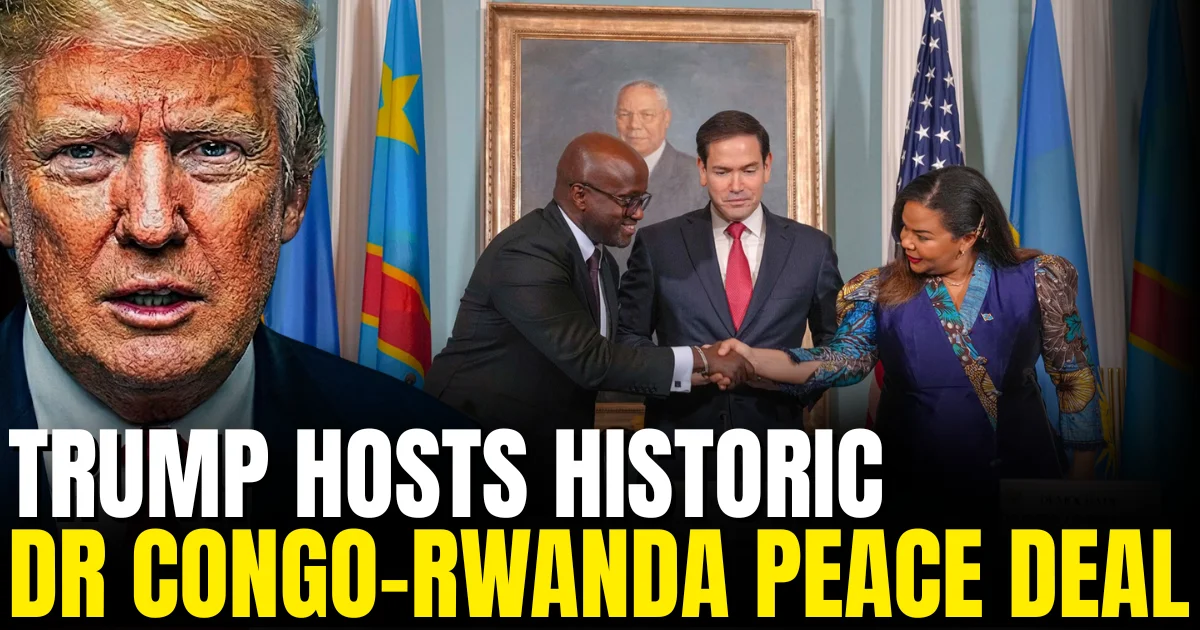
Presidents Tshisekedi and Kagame sign US-brokered peace accord ending conflict. Mineral wealth, M23 rebels, and regional stability explained.
Table of Contents
Trump Hosts DR Congo-Rwanda Peace Deal Signing 2025
Introduction
Washington will witness a potentially historic diplomatic moment as Democratic Republic of Congo President Felix Tshisekedi and Rwandan leader Paul Kagame prepare to formalize a peace agreement brokered by the Trump administration. The White House summit aims to conclude decades of regional instability centered on eastern Congo’s resource-laden provinces.
This presidential-level ceremony builds on preliminary accords signed by both nations’ foreign ministers during June meetings. Multiple African and Middle Eastern heads of state will attend, including representatives from Burundi and Qatar, underscoring the international dimension of central Africa’s most persistent security crisis.
Yet battlefield realities cast shadows over diplomatic optimism. Fresh combat erupted this week between government forces and M23 insurgents, raising questions whether signatures on documents can translate into durable stability on the ground.
Understanding the Central African Conflict
Decades of Regional Instability
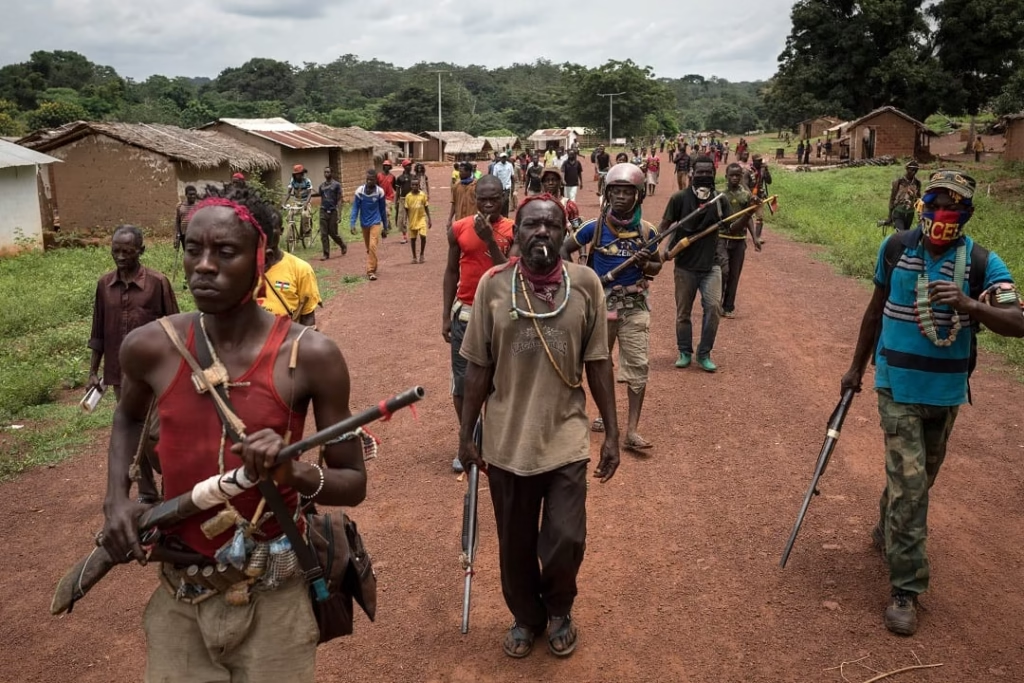
Eastern Congo has endured continuous violence stemming from complex local, national, and international factors:
| Conflict Element | Description |
|---|---|
| Primary battleground | Resource-rich eastern DR Congo provinces |
| Main rebel force | M23 movement (allegedly Rwanda-backed) |
| Government position | Accuses Rwanda of proxy warfare |
| Rwandan justification | FDLR militia threat from genocide perpetrators |
| International involvement | UN peacekeepers, neighboring nation troops |
| Civilian impact | Thousands killed, massive displacement |
Recent Military Developments
Early 2025 witnessed dramatic territorial shifts when M23 forces launched sweeping operations capturing major urban centers including Goma and Bukavu. These strategic cities serve as economic hubs for Congo’s eastern region.
The offensive displaced tens of thousands while killing thousands more, according to humanitarian organizations tracking the crisis. Goma, positioned on the Rwandan border, remains under rebel administration despite ongoing international pressure for withdrawal.
Tuesday’s Pre-Summit Violence
Competing Accusations
Hours before scheduled Washington talks, both sides accused opponents of ceasefire violations and deliberate peace process sabotage.
Congolese military claims: Gen. Sylvain Ekenge alleged M23 launched fresh attacks Tuesday targeting South Kivu province villages approximately 75 kilometers from Uvira city, the temporary regional capital since Bukavu’s capture.
Rebel counterclaims: M23 representatives insisted Congolese forces initiated combined air and ground operations against their positions, coordinating with Burundian military units.
Burundi’s silence: The neighboring nation, which deployed several thousand soldiers supporting Congo’s army, has not addressed involvement allegations.
This violence pattern mirrors historical challenges where battlefield dynamics undermine diplomatic initiatives even as negotiations proceed.
The June Foundation Agreement
Foreign Minister Preliminary Accord
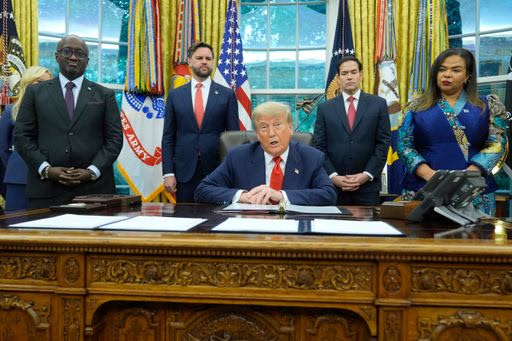
Trump administration officials facilitated initial agreement signing between both nations’ top diplomats in June 2025. The president characterized that ceremony as a “glorious triumph” signaling progress toward comprehensive resolution.
The preliminary framework established principles both presidential leaders will now formally endorse at the Washington summit. However, the intervening months saw continued fighting rather than implementation progress.
Key Diplomatic Players and Interests
Summit Attendance Roster
Beyond the two principal signatories, the ceremony will feature multiple regional and international figures:
- Burundi leadership: Neighboring nation with direct security involvement
- Qatar representatives: Co-mediating parallel negotiations with M23 rebels
- Additional African leaders: Regional stakeholders in Great Lakes stability
- Arab nation delegates: International dimension reflecting global interest
Parallel Negotiation Track
Notably absent from Washington will be M23 rebel leadership. Qatar independently facilitates separate discussions between the insurgent movement and Kinshasa’s government.
This dual-track approach reflects complex realities where state-level agreements don’t automatically translate into rebel compliance. Successful peace requires both international accord and insurgent buy-in.
America’s Strategic Mineral Agenda
Massive Resource Estimates
US State Department assessments from 2023 valued Congolese mineral deposits at approximately $25 trillion—among Earth’s richest concentrations of technology-critical materials.
| Mineral Resource | Industrial Application |
|---|---|
| Cobalt | Electric vehicle batteries, electronics |
| Copper | Electrical wiring, renewable energy systems |
| Lithium | Battery technology, energy storage |
| Manganese | Steel production, battery cathodes |
| Tantalum | Smartphones, computers, military hardware |
Trump’s Explicit Interest
The president openly acknowledged American commercial motivations preceding June’s preliminary agreement. He stated the US would obtain “a lot of the mineral rights from the Congo as part of it,” directly linking diplomatic engagement with economic extraction opportunities.
This transparency about resource interests distinguishes current American diplomacy from traditional approaches emphasizing purely humanitarian or security rationales for peace facilitation.
The Rwanda-FDLR Dimension
Genocide Legacy Complications
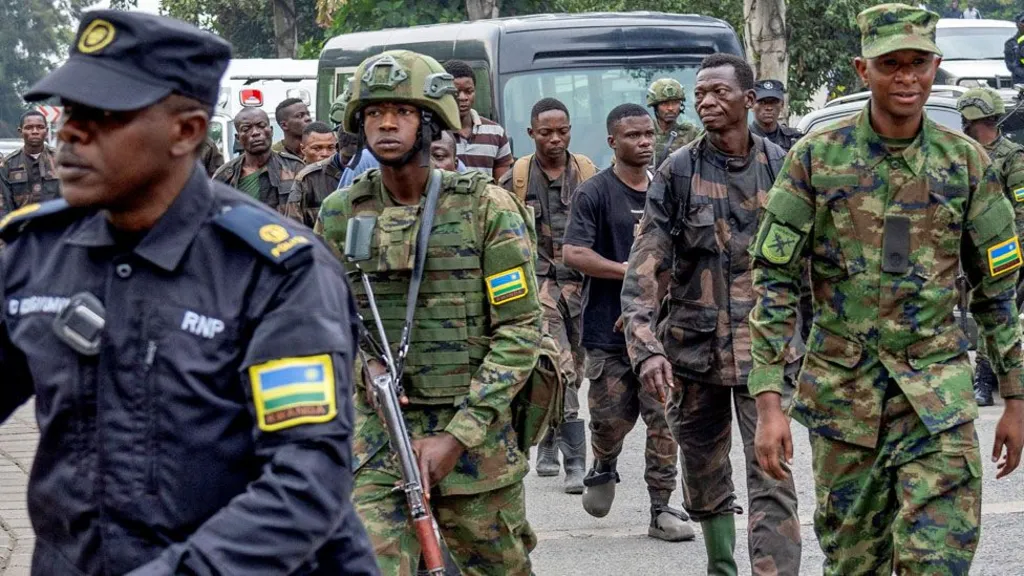
Rwanda justifies eastern Congo military involvement citing threats from FDLR militia forces. This armed group includes individuals who participated in the 1994 Rwandan genocide that killed approximately 800,000 people, predominantly from the Tutsi ethnic community.
Kigali demands FDLR disarmament and elimination as non-negotiable security requirement. President Kagame frames military actions as “defensive measures” protecting Rwanda from genocide perpetrators operating across the border.
Conversely, Kinshasa insists on complete Rwandan troop withdrawal as the primary peace condition, viewing FDLR concerns as pretexts for territorial expansion and resource exploitation.
Mutual Disarmament Provisions
The agreement being formalized addresses both positions, requiring simultaneous FDLR dismantling and Rwandan force removal. This mutual obligation structure mirrors previous failed peace frameworks stretching back to the 1990s.
Historical pattern shows Kigali consistently accused prior Congolese governments of insufficient FDLR disarmament efforts, using this justification for continued cross-border operations. Breaking this cycle represents the accord’s central challenge.
M23’s Territorial Demands
Rebel Consolidation Strategy
M23 leadership refuses surrendering captured territory in Qatar-mediated discussions. The movement continues expanding control zones and establishing administrative structures in occupied cities.
This territorial consolidation creates facts on the ground that complicate diplomatic solutions. Rebels view held territory as negotiating leverage and governance legitimacy foundation rather than temporary military gains.
Kinshasa demands complete territorial restoration as peace prerequisite, creating fundamental impasse in the parallel negotiation track.
Expert Skepticism About Durability
Analytical Doubts
Bram Verelst, researching Congo issues for South Africa’s Institute for Security Studies, expressed doubts about the summit’s practical impact. He noted “currently no ceasefire in place, and the M23 rebellion continues to expand and consolidate its control.”
Verelst suggested the ceremony might marginally “increase accountability on Congolese and Rwandan leaders to honour their commitments” but won’t fundamentally alter battlefield realities.
This skepticism reflects broader pattern where high-profile diplomatic moments generate headlines without producing substantive violence reduction or political settlement.
Historical Context of Failed Agreements
Recurring Peace Process Collapse
Multiple previous frameworks dating to the 1990s followed similar trajectories: initial optimism, formal signatures, gradual implementation failure, renewed conflict.
The common breakdown point involves Rwanda claiming insufficient Congolese action against FDLR forces, while Congo accuses Rwanda of using this justification for continued territorial presence and rebel support.
Until this fundamental trust deficit resolves, even well-intentioned agreements risk repeating historical patterns.
FAQs About DR Congo-Rwanda Peace Deal
1. What are Trump and the US gaining from this peace deal?
The president explicitly mentioned obtaining mineral rights for the United States. Congo holds an estimated $25 trillion in deposits including cobalt, lithium, copper, and other materials critical for electronics, electric vehicles, and military technology.
2. Who are the M23 rebels in DR Congo?
M23 is an insurgent movement controlling large portions of eastern Congo including major cities Goma and Bukavu. UN experts state Rwanda exercises “de facto control of M23 operations,” though Kigali denies providing support.
3. Why does Rwanda intervene militarily in Congo?
Rwanda cites security threats from FDLR militia, which includes fighters who participated in the 1994 genocide. Kigali demands this group’s complete disarmament as a non-negotiable security requirement justifying military presence.
4. Have previous peace deals between Congo and Rwanda worked?
No. Multiple agreements since the 1990s collapsed after Rwanda accused Congo of failing to disarm FDLR forces. This creates a recurring pattern where signed deals don’t produce lasting peace or troop withdrawals.
5. Will the M23 rebels participate in the Washington peace summit?
No. M23 leadership engages in separate Qatar-brokered talks with Congo’s government. The Washington summit involves only state-level participants, creating a dual-track negotiation structure that must both succeed for comprehensive peace.
Conclusion
The Washington summit represents another attempt at resolving central Africa’s most intractable conflict through high-level diplomacy backed by American commercial interests. Whether presidential signatures can succeed where previous agreements failed depends on implementation mechanisms, accountability structures, and genuine commitment from all parties.
Recent battlefield escalation immediately preceding the ceremony illustrates the gap between diplomatic theater and ground-level realities. Meanwhile, M23’s continued territorial expansion and refusal to withdraw creates parallel obstacles beyond state-level negotiations.
The coming months will reveal whether this agreement joins the long list of failed peace frameworks or breaks the cycle through genuine compromise and enforcement.
Will this peace deal finally bring stability to eastern Congo? Share your analysis in the comments and explore our coverage of African geopolitics and resource conflicts.