
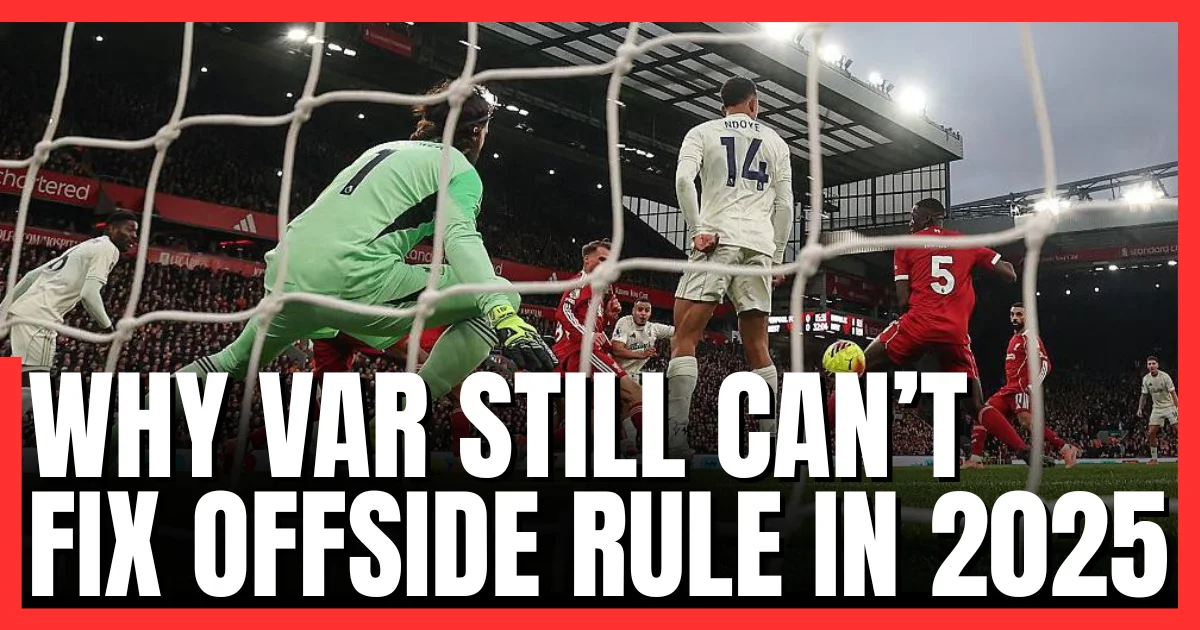
Premier League offside controversies expose VAR limitations. Discover why subjective interference calls remain football’s biggest debate.
Table of Contents
Offside Rule Confusion: Why VAR Can’t Solve It in 2025
Introduction
Premier League matches continue generating heated debates over how officials interpret offside interference with goalkeepers. Recent weekends delivered contradictory rulings that left clubs, pundits, and supporters equally baffled about what constitutes legitimate obstruction.
Liverpool endured opposing outcomes in back-to-back fixtures despite nearly parallel circumstances. Meanwhile, Tottenham watched helplessly as Arsenal scored with three attackers positioned between ball and goalkeeper in apparent violation of established principles.
These episodes demonstrate why technology alone cannot eliminate football’s most persistent officiating headache.

Weekend Controversy Breakdown
Liverpool’s Contrasting Fortunes
The Merseyside club experienced subjective offside from both painful perspectives across two matches:
Versus Manchester City: Officials cancelled a Liverpool goal citing minimal interference that VAR upheld.
Versus Nottingham Forest: Murillo’s opener counted despite Dan Ndoye positioned directly before Alisson as the shot arrived.
Identical technology reviewed comparable situations yet produced opposite conclusions. One cost Liverpool a goal; the other conceded one.
The Arsenal-Tottenham Incident
Eberechi Eze’s strike for Arsenal against Spurs raised eyebrows throughout English football. Three Gunners occupied offside territory in front of Guglielmo Vicario:
- Bukayo Saka positioned centrally
- Martin Zubimendi near the action
- Leandro Trossard in the sight line
Former international goalkeeper Joe Hart insisted on Match of the Day that Trossard’s placement clearly obstructed Vicario’s vision. Officials disagreed, allowing the goal after video examination.
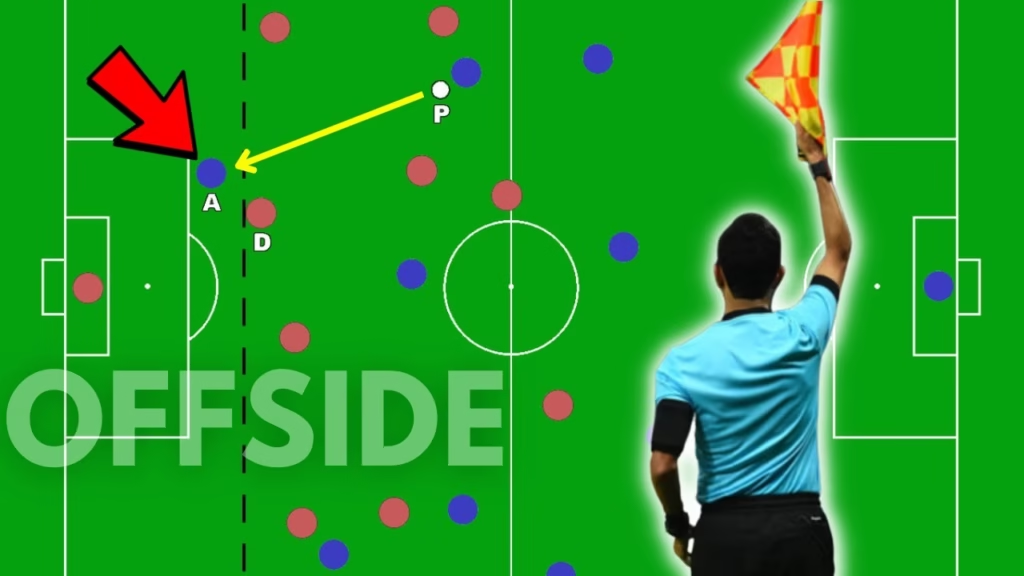
The 122-Year-Old Problem
Ancient Roots of Modern Confusion
Contemporary frustration with offside interpretation didn’t originate with video technology introduction.
| Time Period | Official Wording | Interpretation Required |
|---|---|---|
| 1903-04 season | Players cannot “in any way whatsoever interfere” | “Any way” demands subjective judgment |
| Current era | Multiple interference scenarios defined | Each situation needs individual assessment |
| Duration | Over 12 decades | Continuous debate |
Football has wrestled with this exact challenge since the Edwardian era. Officials have always faced impossible tasks determining when non-contact involvement crosses the interference threshold.
Understanding Subjective Assessment Challenges
Questions Without Objective Answers
Every goalkeeper interference decision requires officials to evaluate inherently subjective factors:
Visual blocking: How much sight line obstruction creates genuine impact versus negligible presence?
Player trajectory: Do movements toward or away from action matter equally?
Ball tracking ability: Can keepers still follow the ball despite nearby opponents?
Psychological impact: Does mere proximity cause meaningful hesitation affecting reactions?
These human perception elements resist conversion into measurable data points suitable for technological resolution.
Video Technology’s Narrow Scope
Built-In Limitations
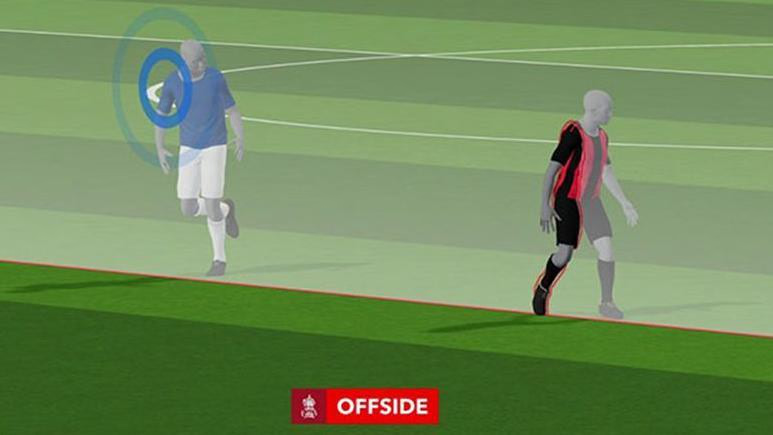
VAR operates under deliberately restrictive parameters for subjective offside scenarios:
- Intervention threshold: Only “clear and obvious” errors warrant overturning
- On-field deference: Original calls receive benefit of doubt
- Infrequent overrides: Marginal situations almost never trigger changes
- Pattern inconsistency: Comparable moments yield different outcomes
Statistical Evidence of Restraint
Recent Premier League data reveals how seldom VAR modifies these judgment calls:
| Competition Year | Category | Frequency |
|---|---|---|
| 2023-24 campaign | Vision obstruction goals awarded | 2 instances only |
| 2023-24 campaign | Vision obstruction goals cancelled | 4 instances total |
Such minimal intervention rates prove most disputed situations never meet the overturn standard despite widespread disagreement from fans and media.
Case Study Collection
When VAR Restored Goals
Two specific instances saw technology reverse initial disallowances:
- Bernardo Silva striking for Manchester City away to Wolves
- Jamie Vardy finding the net for Leicester visiting Fulham
Officials originally flagged both but video review determined no clear interference occurred.
When VAR Cancelled Scores
Four separate goals fell to video review interventions:
- Rasmus Hojlund effort for Manchester United against Burnley
- Mohamed Salah attempt for Liverpool facing Burnley
- Lorenz Assignon contribution for Burnley at Crystal Palace
- Tawanda Chirewa finish for Wolves hosting West Ham
Each featured distinct positioning nuances preventing straightforward precedent application to future scenarios.
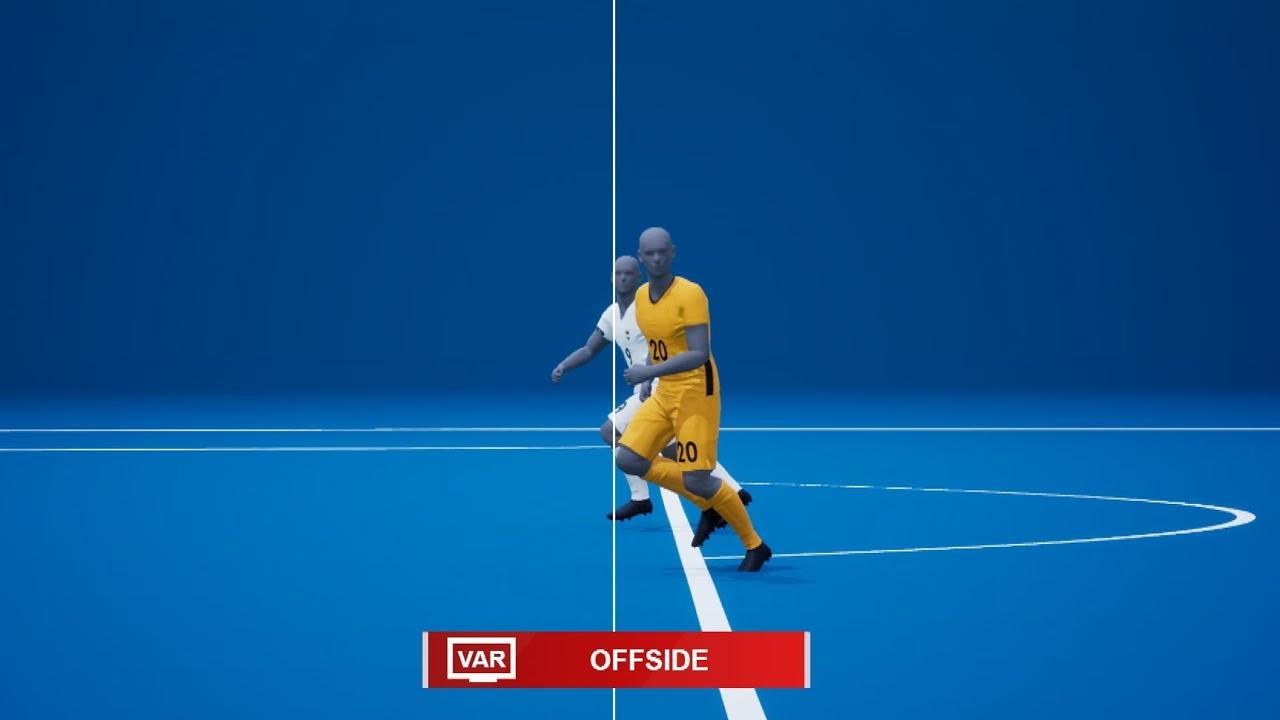
Exploring Potential Fixes
Absolute Zone Approach
Some suggest automatic interference designation for any offside player inside the six-yard box.
Benefit: Eliminates all interpretation by creating binary standard.
Fatal flaw: Would cancel goals when offside players stand at the far post completely removed from goalkeeper location and ball path. This produces absurd outcomes contradicting sporting logic.
Measurement-Based Criteria
Establishing precise distance, angle, and position metrics could theoretically remove human judgment.
Benefit: Provides consistent application across all scenarios.
Fatal flaw: Handball law evolution demonstrates how adding objective thresholds simply generates more cancelled goals without improving perceived fairness or common sense outcomes.
Enhanced VAR Intervention
Permitting video officials to examine all subjective offside regardless of error obviousness.
Benefit: Ensures thorough review of contentious moments.
Fatal flaw: Dramatically extends match stoppages while still requiring subjective human assessment at the review station rather than eliminating interpretation.
The Impossibility of Perfect Uniformity
Why Consistency Remains Elusive
Genuinely identical offside situations never exist due to variable combinations:
- Precise coordinate positioning of multiple players
- Movement velocities and directional vectors
- Ball speed, spin, and trajectory path
- Goalkeeper stance, positioning, and motion
- Angle and degree of visual obstruction
- Temporal relationship between movements and shot
Supporters instinctively compare superficially similar cases. However, these subtle distinction prevent treating any single ruling as binding precedent for supposedly comparable future incidents.
Professional Insight Limitations
Even Experts Disagree
Joe Hart’s Match of the Day analysis exemplifies how elite-level experience doesn’t produce consensus. His goalkeeper background provides relevant expertise yet other equally qualified voices reach different conclusions.
Hart contends that slow-motion replay capability should enable identifying definite obstruction. Yet identical technological tools in different officials’ hands produce contradictory judgments on parallel plays.
This expert disagreement proves the problem transcends competence, instead reflecting inherent subjectivity.

FAQs About Offside Interference Debates
1. Why doesn’t VAR fix all controversial offside decisions?
Video officials only intervene when on-field calls constitute “clear and obvious errors.” When legitimate interpretations support both allowing and cancelling a goal, VAR maintains the referee’s original judgment rather than imposing alternative subjective views.
2. How do officials determine goalkeeper interference?
Referees assess whether offside players obstruct vision, make movements affecting keeper positioning, or prevent ball-playing attempts. These evaluations require judgment about genuine impact versus incidental presence.
3. Is offside interference confusion a recent development?
Absolutely not. Official football laws from 1903-04 already contained subjective phrasing about interference “in any way whatsoever.” This interpretation challenge predates modern football by over 120 years.
4. Can technological advances eliminate offside subjectivity?
Technology accurately determines player positions but cannot objectively measure whether those positions meaningfully affect play. The interference assessment will always require human interpretation regardless of available tools.
5. Why don’t identical-looking situations receive consistent rulings?
Perfect similarity never exists between separate incidents. Minor variations in positioning coordinates, movement patterns, ball flight, and goalkeeper sight lines create unique circumstances justifying different conclusions from officials.
Conclusion
Goalkeeper interference controversies expose football’s fundamental tradeoff between maintaining match rhythm and achieving absolute fairness. Despite understandable fan demands for consistency, the subjective nature of obstruction assessment prevents achieving total uniformity.
Solutions creating complete objectivity would likely trigger worse unintended consequences than current frustrations. Football appears permanently committed to debating these borderline calls no matter how sophisticated technology becomes.
The sport’s humanity includes both its beauty and its imperfections—perhaps the ongoing debate forms part of football’s enduring appeal.
How would you solve offside confusion? Join the conversation below and check our other football rule analysis articles.